

Treatment options for using donor sperm
Discover donor sperm treatment options with Genea including IVF, IUI and ICSI. Expert guidance for all family types on choosing the right fertility treatment.
Using donor sperm for IVF, IUI, or ICSI can be an excellent option for anyone looking to build their family. When working with trusted clinics like Genea Fertility, thoroughly screened, healthy sperm donors can contribute to better success rates and peace of mind.
With comprehensive support, expert guidance, and access to diverse donor profiles, fertility treatments with donor sperm open the door to creating a healthy, happy family, tailored to your unique circumstances and desires.
Using donor sperm with your fertility treatment
Choosing to have a child through IUI or IVF with donor sperm is a profound and life-changing decision, offering flexible, medically supported pathways tailored to the unique needs of single women, heterosexual couples, and LGBTIQA+ families.
More people are embracing the empowering experience of solo motherhood, supported by access to meticulously screened, high-quality donor sperm that provides peace of mind and increases the chances of a successful pregnancy. For heterosexual couples facing male infertility or hereditary health concerns, sperm donation offers a hopeful and effective path to parenthood.
Who should consider treatment with donor sperm?
Your treatment journey starts with a comprehensive fertility assessment with one of our experienced fertility specialists. During these consultations, we will determine whether assisted reproduction with donor sperm will provide you with the best chance of achieving your desired family. The decision to proceed will be guided by your fertility doctor but made in collaboration with you, accounting for your personal preferences and family goals.
Fertility treatment with donor sperm may be the right option when:
Sperm is needed to build your family whether you're unable to produce sperm, sperm quality is a concern, or sperm isn't available from your intended family structure, donor sperm provides a pathway to parenthood.
There are genetic considerations if reproductive genetic carrier screening reveals an increased risk of passing on a genetic condition, donor sperm can help avoid this risk. All clinic-recruited donor sperm has been comprehensively screened for genetic conditions.
All clinic-recruited sperm donors are thoroughly screened for infectious diseases, genetic conditions, and other healthcare issues that could impact pregnancy or donor-conceived children. This process ensures we provide only quality sperm for treatment, maximising your chances of successfully building your family.
IUI with donor sperm (Intrauterine Insemination)
Intrauterine insemination (IUI) is often viewed as a less invasive assisted reproductive technique compared to in vitro fertilisation (IVF). For many individuals and couples looking for donor sperm, our fertility specialists recommend this approach as the first option if fertility tests indicate there may be a good chance of success with IUI.
How does IUI donor insemination work?
Intrauterine insemination with donor sperm is often referred to as "donor insemination". The procedure is very similar to the conventional IUI process but requires the additional steps of selecting and preparing the donor sperm for insemination.
Key considerations specific to using donor sperm:
Donor selection: You will first need to select your sperm donor. Our Genea donor team is here to support you through this process.
Sperm preparation: The donor sample is washed and prepared by the Genea andrology team, removing excess fluids and any debris. The result is a highly concentrated semen sample containing only healthy, motile sperm.
Monitoring: You'll typically attend a Genea clinic every 2 or 3 days for blood tests and ultrasound scans to identify when you are expected to ovulate.
The donor insemination procedure is quick and not typically considered painful; most patients don't need anaesthesia and can return to their usual daily activities immediately.
Success rates with IUI donor insemination
The success rates of donor insemination will vary depending on several factors, the most predominant one being your age and quality of your eggs. In general, if the person contributing the eggs is under 35 years old, the chances of a pregnancy are around 21%; if this person is between 35 and 39 years old, success rates sit around 15% per cycle.
If you are unsuccessful with donor insemination after two or three cycles, our fertility specialists will discuss moving on to IVF.
Donor insemination is not likely to be an appropriate treatment option if the person contributing the eggs or intending to carry the pregnancy:
- Is over 38 years old
- Has a blockage or damage to their fallopian tubes
- Has severe endometriosis
IVF with donor sperm (In Vitro Fertilisation)
Though in vitro fertilisation (IVF) is the most well-known assisted reproductive technology, only about 50% of our patients at Genea end up building their families through this method. Our fertility specialists use their expertise to explore all treatment options that may be suitable for your situation and will only recommend IVF with donor sperm if other strategies are unlikely or have proven not to be successful.
How does IVF with donor sperm work?
The IVF process using donor sperm follows the same steps as IVF using partner-provided sperm. With the support of the Genea counselling team and your donor coordinator, you will choose your sperm donor in advance before commencing the IVF process.
Key considerations specific to donor sperm:
Sperm preparation and quarantine: All donor sperm samples (whether from known or clinic-recruited donors) must be frozen and quarantined for three months to allow for comprehensive health screening before they can be used. On the day of your egg retrieval, we thaw the frozen sperm sample to maximise its integrity and prepare it for fertilisation.
Genetic testing options: While all donor sperm provided through Genea has been screened for genetic disorders, you may choose for your embryos to undergo preimplantation genetic testing (PGT). Abnormal chromosome numbers or arrangements can still occur during the fertilisation process, and PGT enables our embryologists to select only chromosomally normal embryos for transfer.
One full IVF cycle takes around 4 weeks. However, factoring in your initial appointment with your fertility specialist, through the donor selection process, IVF treatment, and pregnancy test, this may take up to 4 months.
Success rates with IVF using donor sperm
At Genea, the likelihood of falling pregnant using donor sperm with the IVF process is similar, if not better, than IVF using partner-provided sperm. This is thought to be due to the intensive screening process applied to all sperm donors in Australia and from our global sperm bank partners.
There are several factors that can contribute to your chances of a successful pregnancy and a healthy baby conceived through IVF and donor sperm. One of these is your own fertility and general health, as the person providing the eggs and carrying the pregnancy. Another significant factor is your age, as natural fertility declines rapidly after the age of 35. For women under 35 years old, the rates of success per cycle are around 54%. For those over the age of 35, the likelihood of a live birth sits around 30%. We are pleased to report IVF success rates for all ages that are consistently higher than the national average.
ICSI with donor sperm (Intracytoplasmic Sperm Injection)
Intracytoplasmic sperm injection (ICSI) is an advanced form of in vitro fertilisation (IVF), and is used in specific circumstances to boost your likelihood of a successful pregnancy. Your fertility specialist will provide you with guidance based on their assessment of your situation.
How does ICSI with donor sperm work?
Prior to embarking on your fertility treatment, you will select your chosen sperm donor. This can be a daunting process but our Genea donor team is here to support you through every step.
Key considerations specific to donor sperm:
Donor selection support: Prior to embarking on your fertility treatment, you will select your chosen sperm donor. This can be a daunting process but our Genea donor team is here to support you through every step.
Sperm preparation: On the day of your egg retrieval, your donor sperm will be prepared in the laboratory, where our embryologists separate the healthy sperm cells for fertilisation through the ICSI process.
Genetic testing options: During embryo development, you may choose for these embryos to undergo preimplantation genetic testing (PGT), which assesses each individual embryo for a range of genetic disorders. This allows us to determine which embryos have the highest potential for developing into a healthy baby.
Success rates with ICSI using donor sperm
If you’re a female using your own eggs for the ICSI procedure, the rates of success generally decrease in older age across all types of procedures, whether you are using donor sperm or partner sperm. This is because egg quality declines with age.
We achieve fertilisation rates of around 70 - 85% when injecting a sperm cell directly into an egg. At Genea, this translates to a live birth success rate of 41% for women under 35 years old, and 21% for women over 35, when using their own eggs.
Choosing the right treatment option
Medical tests and fertility assessments are conducted to determine the best approach for your individual circumstances. Your fertility specialist will consider multiple factors when recommending whether IVF, IUI, or ICSI is most suitable for your situation.

Ready to find your perfect donor?
Our experienced team guides you through selecting the right sperm donor with confidence and support at every step.
FAQs
Because donor sperm comes from carefully screened, healthy donors, success rates are typically high and often comparable to treatments using non-donor sperm. Success rates vary by treatment type, age, and individual factors, with your fertility specialist able to provide personalised success rate estimates based on your specific circumstances.
The number of treatment cycles needed before achieving a live birth will vary from case to case. Your fertility specialist will provide a more accurate estimate based on your individual circumstances, accounting for your age, fertility factors, and the type of fertility treatment. It is not uncommon to require multiple cycles before succeeding with a pregnancy. We recommend accounting for this in your financial planning and work commitments.
Yes, your fertility specialist will guide you in choosing the most appropriate treatment type, based on your personal preferences, your own reproductive health, and your chosen donor sperm. In some cases, it may be reasonable to start with the less-invasive IUI procedure and if this is unsuccessful, IVF may be the next step. In other situations, you may be advised that the donor sperm you have selected can only be used with ICSI. These conditions will be clearly indicated on the donor profile.
Treatment costs vary significantly between procedures, with IUI being the most affordable option and ICSI typically the most expensive. Your fertility specialist will discuss cost implications alongside medical recommendations to help you make the best decision for your circumstances and budget.
From your first fertility specialist consultation to confirming your chosen donor, it can take 2-4 months. This process includes any necessary fertility testing, your counselling sessions, browsing our extensive donor databases, making your selection, and undertaking donor-specific genetic counselling. If your counsellor recommends you have reproductive genetic carrier screening, this can extend the timeline by an additional several months.
Once you have confirmed your sperm donor, one treatment cycle of IUI/IVF/ICSI typically takes about 4 weeks.
We provide comprehensive support including fertility counselling, medical care from specialist doctors and nurses, donor coordination services, financial counselling, and access to support groups. Our team understands the unique aspects of donor sperm treatment and provides ongoing guidance throughout your journey.
Yes, many donors are available to provide sperm for multiple treatment cycles, including to add siblings to your family. If you are planning to expand your family in the future and would like to use sperm from the same donor, you may view the number of sperm samples available on the donor’s profile. Some of our sperm bank partners also allow clients to reserve a certain number of vials for future siblings. Australian state laws impose a limit of how many families one sperm donor can contribute to; if this family limit has been reached by your chosen donor, you will need to consider an alternative donor for subsequent treatments.
Genea is a leading fertility provider for same-sex couples in Australia, offering specialised treatment options including reciprocal IVF and surrogacy coordination, with independently audited success rates that consistently exceed national averages.
Choosing the right fertility provider means finding a clinic that offers not just medical excellence, but genuine understanding and inclusive care. At Genea, we see your family as exactly that: your family, deserving of the same expert treatment and support as everyone else.
What sets Genea apart for LGBTQIA+ families:
- Comprehensive treatment expertise: Our specialists have extensive experience coordinating reciprocal IVF treatment between both partners using donor sperm. For couples exploring surrogacy, we guide you through this complex but rewarding pathway with expert coordination of donor eggs and surrogate matching.
- Proven outcomes: Our independently audited success rates consistently exceed national averages across all age groups (NPESU data), meaning you're choosing a clinic with proven outcomes, not just good intentions.
- LGBTQIA+ specialist support: Dedicated coordinators and counsellors who understand the unique considerations you're navigating, from legal parentage to explaining your family's story to your future children. We don't just accommodate diverse families, we celebrate them.
- Extensive donor choice: Access one of Australia's most diverse donor databases through our partnerships with leading international sperm banks and locally recruited Australian donors, giving you genuine choice in finding the right match for your family.
Genea has been supporting LGBTQIA+ families for years, and we're proud of the trust same-sex couples place in us. We believe everyone deserves to become a parent with dignity, respect, and the best possible chance of success, and we're committed to making that a reality across Australia.
Preparing for your treatment journey
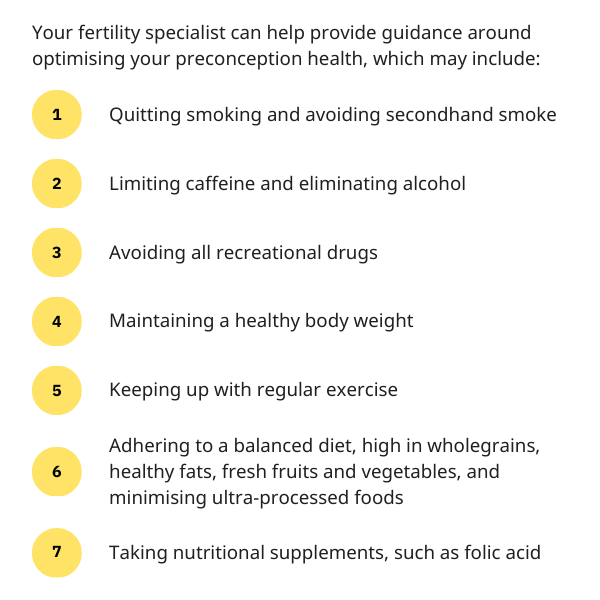
Optimise your preconception health
Even if you’re conceiving with the help of donor sperm and assisted reproductive technology, ensuring your own body is ready for pregnancy can help to improve your treatment success.
Review your overall health and wellbeing
Certain medical conditions such as diabetes, thyroid disorders, and gynaecological conditions including uterine adhesions (Asherman’s syndrome) and endometriosis can affect your egg quality, fertility, and risk of pregnancy complications. Your fertility specialist and other clinicians in your healthcare team can work together to address these issues, making sure that any impact of these conditions on your likelihood of treatment success is minimised.
Prepare yourself emotionally
Any form of fertility treatment can be an emotional rollercoaster, and treatment with donor sperm is no different. The Genea donor team is available to provide support through counselling, advice, and referral to external support groups if needed.
You may also find it helpful to empower yourself with knowledge through talking with others who have been through this journey and doing your own research. Doing this can make you feel more confident, give you the tools to advocate for yourself, and make informed decisions that you feel comfortable with.
If you are embarking on the donor treatment journey as a couple, we recommend having open and honest conversations with your partner about values, priorities, and expectations. This may include how many treatment cycles you are willing to undertake before considering other options, your financial situation, and donor selection criteria. Part of your treatment process will include a joint counselling session, where our Genea counsellors can facilitate a productive conversation around these topics.



.png "Genea logo")
.png)
